Innovation & Tech
4 min read

Isoclima Group
25/08/2026
Share this post
Producing curved glass requires specific technical expertise and rigorous control at every stage of the process. From automotive to aerospace applications, through to marine and architectural security sectors, glass bending meets increasingly complex design requirements, where geometric precision and mechanical strength must coexist without compromise.
In this article, we examine the main bending technologies, the applicable dimensional tolerances and the quality control criteria that ensure the finished product complies with the standards required by different industrial sectors.
Thermal Bending (Gravity Bending, Press Bending)
Thermal bending is the most widely used process for producing curved glass on a large scale. The underlying principle is simple: the glass is heated until it reaches its softening temperature, generally between 600°C and 650°C, and is then shaped according to the required geometry.
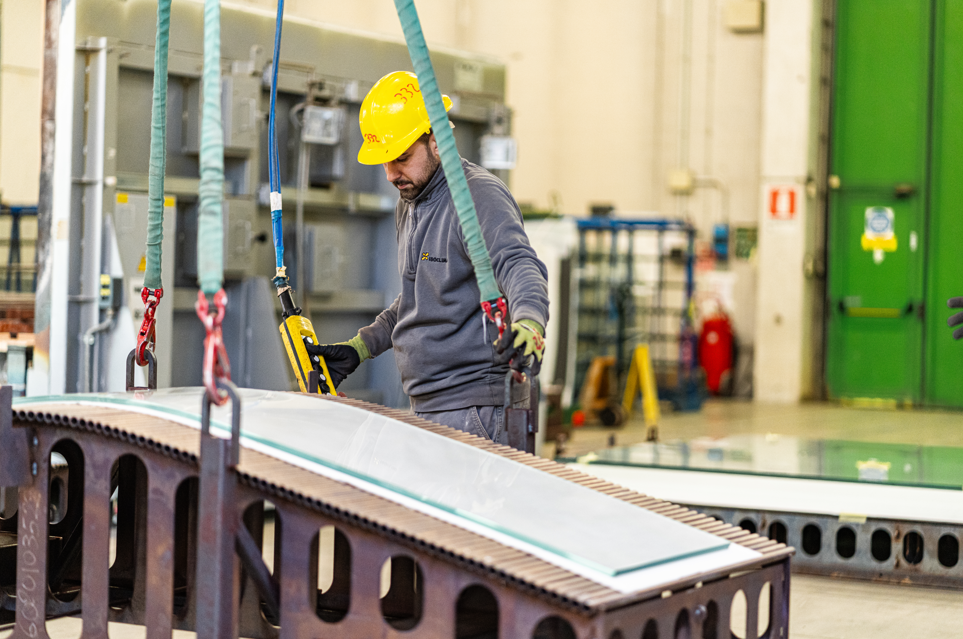
In gravity bending, the heated sheet is placed on a shaped mould and takes on the required form under its own weight, without the intervention of external compressive forces. This method is particularly suited to simple curvatures and large surfaces, where optical quality must remain high across the entire extension of the sheet.
Press bending, on the other hand, uses two complementary moulds that compress the heated glass, imprinting more complex geometries and tighter bending radii than gravity bending. This technique allows for greater dimensional repeatability and is suited to production with stringent geometric requirements, as in the case of components intended for regulated sectors.
Both processes are followed by a controlled cooling phase, which can be aimed at annealing or tempering, depending on the mechanical characteristics required for the final product.
Chemical Bending
Chemical bending is an alternative to thermal processing, used mainly when the required geometry or the characteristics of the glass are not compatible with high-temperature processes. This approach relies on the use of saline solutions which, through a controlled ion exchange, modify the surface properties of the glass, allowing gradual deformation without exposure to high temperatures.
The process is applied in contexts where it is necessary to preserve the material’s optical properties as much as possible, or to work on thicknesses and configurations that cannot be managed with traditional thermal methods. It is generally a slower process than thermal bending, but capable of offering a higher level of precision on complex geometries.
Geometric Tolerances
Defining geometric tolerances is a central element in the design of curved glass components, particularly for applications where the glass is integrated into structures and mechanical systems with stringent dimensional requirements.
Applicable tolerances vary depending on several factors: the bending process used, the thickness of the sheet, the required bending radius and the overall dimensions of the component. In general, press bending allows for tighter tolerances than gravity bending, thanks to the direct control exerted by the moulds during forming.
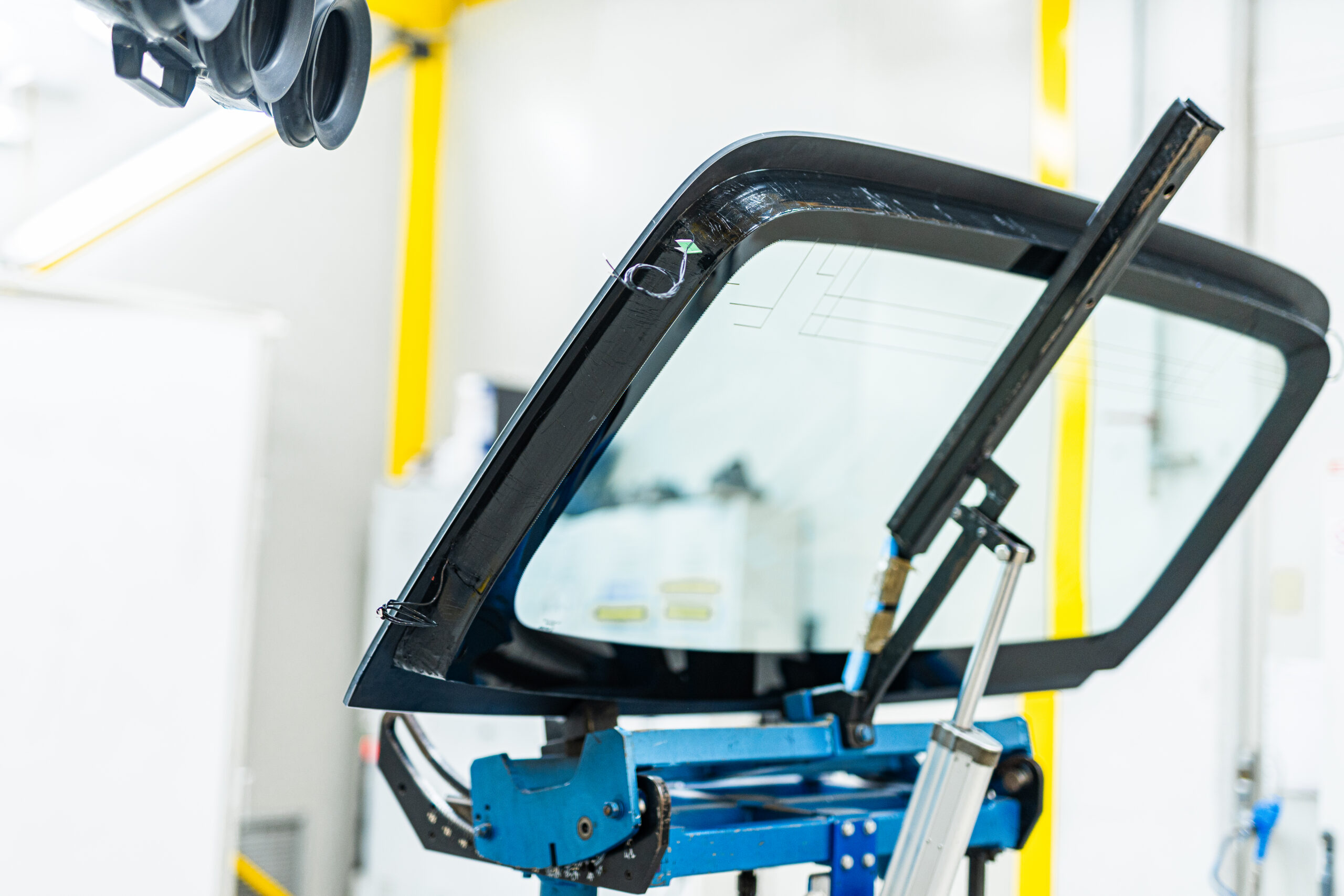
Parameters such as residual flatness, deviation from the theoretical profile and uniformity of the bending radius are defined during the design phase and verified using dedicated instrumentation, to ensure full compatibility of the component with the final assembly.
Quality Control
Quality control in curved glass production takes place throughout the entire production cycle, from raw material selection to verification of the finished product. Each sheet undergoes dimensional checks to confirm that the geometry obtained matches the design specifications, with particular attention to bending radius, flatness and optical distortion.
Optical quality is a determining parameter, especially for applications where visibility and the absence of distortion are essential functional requirements, such as cockpits or security glazing. Checks are carried out both in the production environment and through laboratory testing, in compliance with the technical standards applicable to the target sector.
The structural integrity of the glass is also verified, with checks aimed at identifying any residual stress or surface defects that could compromise its performance over time.
Bending Limits by Glass Type
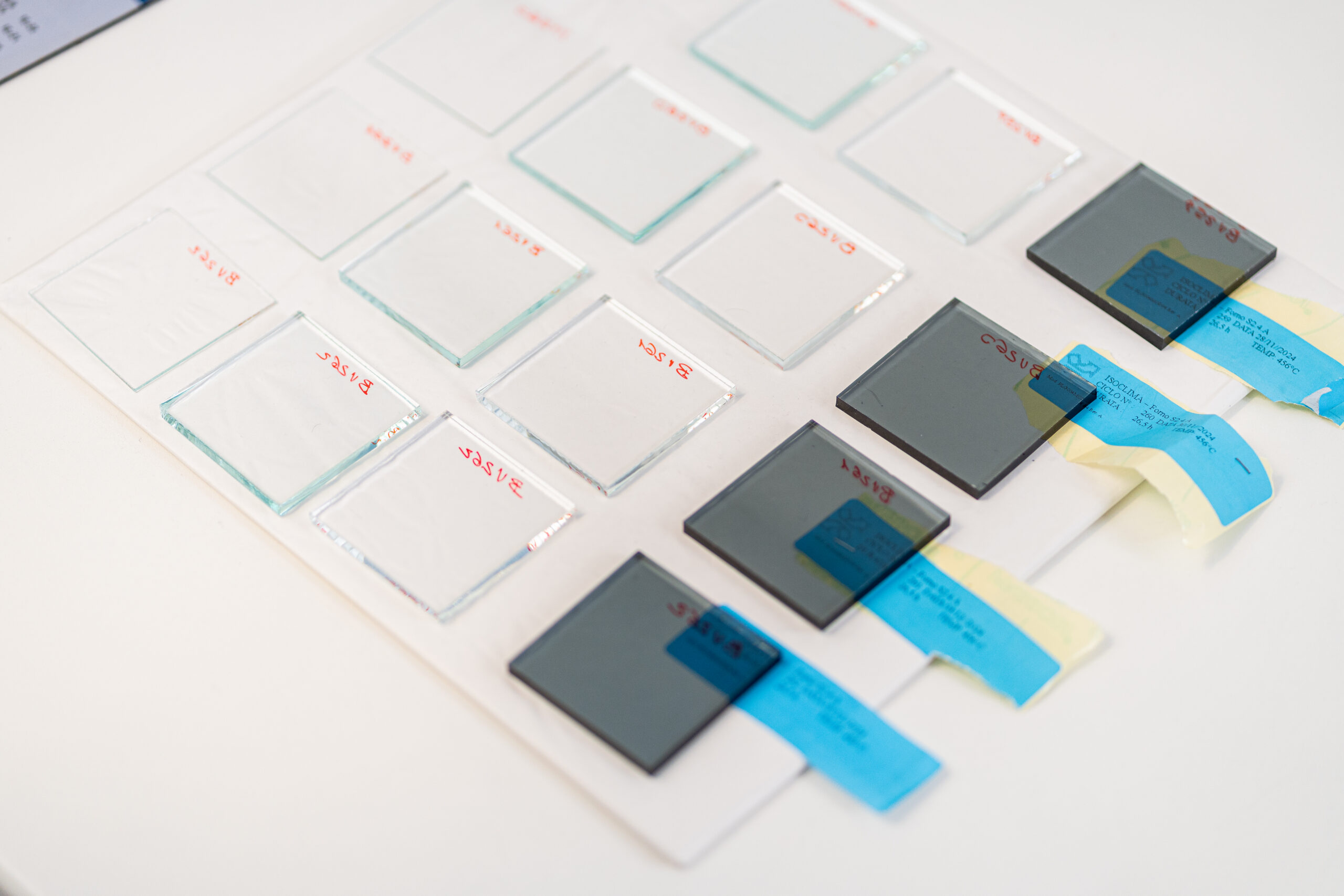
Applicable bending limits largely depend on the type of glass used and its intrinsic characteristics. Standard float glass allows for relatively wide bending radii with traditional thermal processes, while tempered glass, due to the internal stresses generated by the treatment, has more stringent constraints on the geometry achievable after bending.
Laminated glass, made up of multiple layers bonded through polymeric interlayers, requires careful balancing between the curvatures of the individual layers, to avoid differential stresses that could compromise stability over time. In multilayer systems intended for high-performance applications, bending limits are also defined based on the overall thickness of the glass package, which directly affects the formability of the component.
The combination of bending technology, glass type and application requirements therefore defines the design space within which curved glass solutions can be developed to meet the needs of the most demanding sectors, from transportation to defence, through to architectural security applications.