Bulletproof glass is a high-performance material. It is designed to withstand bullets, explosive fragments and forced entry attempts.
Contrary to what the name suggests, it is not simply thick glass. Instead, it is a layered composite system. It combines different materials to guarantee protection, transparency and structural integrity.
Bulletproof glass is used in the military, banking, automotive and architectural sectors. Today, it is a mature technical solution. It is also regulated at European level.
Composition and Materials
Bulletproof glass comes from joining multiple layers of transparent materials. Adhesion promoters bond these layers together. The typical structure includes:
- Layers of float or tempered glass. These provide rigidity and resistance to the initial impact.
- Layers of polycarbonate (PC). This is a thermoplastic polymer with high impact resistance. It absorbs the bullet’s residual energy.
- Interlayers. These hold fragments together if the glass breaks. They also increase energy absorption.
The total thickness of a bulletproof panel usually ranges from 20 mm to over 70 mm. This depends on the level of protection required.
Some advanced systems also add layers of chemically tempered glass or composite materials. Military applications use these especially often. Here, the goal is to reduce weight without lowering ballistic performance.
How It Resists Bullets
The idea behind bulletproof glass is simple: it dissipates the bullet’s kinetic energy gradually. This happens through the different layers of the composite. On impact, three mechanisms activate in sequence.
- First, the outer glass layer deforms and cracks. This layer absorbs the hit. It cracks and starts absorbing energy. As a result, it slows the bullet down and deforms its tip.
- Next, the interlayers absorb energy. The polymer films between the layers stretch elastically. This spreads the energy over a wider surface. It also stops fractures from spreading out of control.
- Finally, the polycarbonate layer stops the bullet. Thanks to its high toughness, this inner layer holds the fragments together. It stops the bullet before it can pass through the panel completely.
So, the system does not “block” the bullet like a wall. Instead, it slows the bullet down step by step until it stops. At the same time, it keeps fragments from flying toward the interior.
EN 1063 Resistance Classes
In Europe, the EN 1063 standard regulates the classification of bulletproof glass. This standard defines seven ballistic resistance classes, from BR1 to BR7. It also adds two classes for resistance to bursts of fire: SG1 and SG2.
Each class depends on three factors: the ammunition used, the bullet’s velocity, and the firing distance.
| Class | Test weapon | Caliber |
|---|---|---|
| BR1 | Rifle | .22 LR |
| BR2 | Handgun | 9 mm Parabellum |
| BR3 | Handgun | .357 Magnum |
| BR4 | Handgun | .44 Magnum |
| BR5 | Rifle | 5.56 × 45 mm |
| BR6 | Rifle | 7.62 × 51 mm |
| BR7 | Rifle | 7.62 × 51 mm |
During testing, each sample takes three shots in sequence. It only passes if none of the shots fully penetrate the panel. Because of this, the standard is the mandatory reference for professional, institutional and governmental supplies.
Main Applications
Automotive
In the automotive sector, armoured vehicles use bulletproof glass. These vehicles often transport institutional figures, diplomats, security personnel and valuables.
The panels must meet strict requirements. These cover curvature, weight and integration with armoured doors. Government vehicles generally need at least class BR6. Civilian VIP applications, on the other hand, often use BR4 or BR5.
Defence
In the military and government sphere, bulletproof glass appears in tactical vehicles, fixed positions, turrets and advanced command structures. Here, multilayer composites combine glass, polycarbonate and ballistic ceramics. The goal is clear: keep the overall weight down while still protecting against armour-piercing ammunition and blast fragments.
Buildings
Architects also use bulletproof glass in banks, embassies, courts, control centres and other high-risk facilities. In these cases, the panels need more than ballistic resistance. They must also meet the aesthetic and thermal requirements of modern buildings.
The EN 1063 standard applies here too. Often, it works alongside EN 356, which covers resistance to manual break-in.
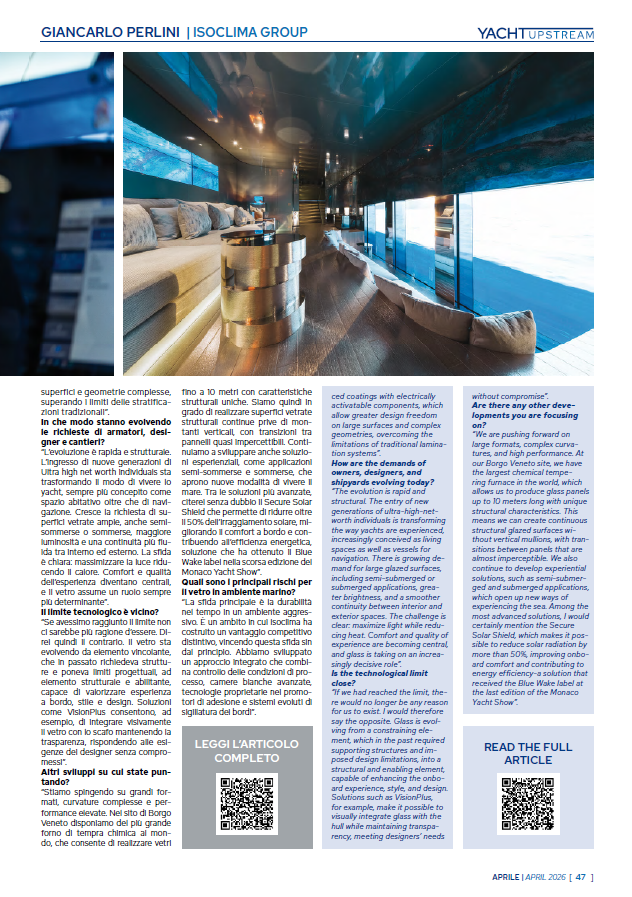
The interview with Giancarlo Perlini, Group Chief Commercial & Marketing Officer of Isoclima Group, published in SUPER YACHT 24, explores the role of advanced glazing in the evolution of the yachting industry.
Three key themes emerge: durability, weight reduction, and solar irradiance management. These are no longer just technical specifications.
They are critical factors shaping the architecture, design, and performance of next-generation yachts.
In today’s context, efficiency and design freedom must coexist. Materials therefore act as a strategic enabler of safety, comfort, and overall performance.
The interview highlights a clear shift: innovation in the sector is increasingly driven by the integration of advanced technical performance into yachts.
Read the full interview now: https://www.superyacht24.it/2026/03/16/perlini-isoclima-group-durabilita-peso-e-irraggiamento/

Artemis II has blasted off toward lunar orbit: The Launch and the 10-Day Journey
Overnight on April 1, 2026, NASA’s Space Launch System (SLS) rocket successfully lifted off from the Kennedy Space Center, carrying the Orion capsule and its crew. This marks a historic milestone: it is the first crewed mission of the Artemis program and humanity’s first journey beyond low Earth orbit since the Apollo era.
A Flawless Liftoff Right on schedule, the rocket executed its launch sequence perfectly:
Main Engine Cutoff: Eight and a half minutes after liftoff, the core stage completed its burn, separated from the upper stage, and began its descent toward a planned ocean splashdown.
Booster Separation: About two minutes into the flight, the twin solid rocket boosters exhausted their fuel and safely detached.
Core Stage Propulsion: The immense task of pushing the spacecraft forward then passed to the four powerful engines of the core stage.
While 86% of companies invest for AI in business, only 43% prepare their employees to use it effectively, and just 19% of workers feel adequately skilled.
Accenture’s “Talent Reinventors” study highlights 18% of organizations that successfully integrate AI into daily work, fostering collaboration and continuous skill development.
These companies see major gains in culture, employee experience, workforce adaptability, and anticipate 2025 revenue and profit growth of 1.8% and 1.4%, respectively.
The transition to AI is having a significant impact on people: 55% of workers report “cognitive overload,” and 49% fear that AI could impact their jobs. Research highlights that the ability to generate value from AI increasingly depends not only on technology but also on leadership, visibility of skills, and psychological safety within organizations.
Link: https://forbes.it/2026/03/31/ai-in-azienda-investimenti-elevati-ma-competenze-ancora-insufficienti
Global Snapshot of waste could increase 50% by 2050 without major policy and investment shifts
The What a Waste 3.0 report warns that without action, annual waste volumes could grow to 3.86 billion tonnes by 2050.
Rising waste volumes will overwhelm existing infrastructure, undermine global economic development and job creation, and threaten public health and the environment.
To fully grasp the scale and urgency of today’s challenges, as well as the opportunities they present, the World Bank Group’s What a Waste 3.0 report offers the most up-to date data and statistical analytics on global solid waste management. Drawing on the most recent publicly accessible data from 217 countries and economies and 262 cities, it provides a framework for understanding how different policy choices and levels of ambition could shape the future of global waste.
Link: https://www.worldbank.org/en/publication/what-a-waste?cid=ECR_LI_worldbank_EN_EXT
The yachting “space race” pushes builders to pack big-boat features into compact designs. Consequently, owners maximize space without exceeding strict Length Overall (LOA) regulations.
But does a widebody design look chunky? Exterior designer Filippo Salvetti disagrees. “Instead, it is an opportunity to give the project greater dynamism,” he explains.
As a result, the yacht boasts a sporty, eye-catching silhouette. Salvetti highlights the contemporary exterior, noting its “sculpted and taut” surfaces.
Furthermore, clean upper deck bulwarks perfectly frame the glazing. Finally, a dynamic sweeping line around the helm adds tension and elegance to the hull.
Added volume, Filippo Salvetti says, “does not necessarily result in a massive, heavy yacht. It all depends on proportions.” Like many yacht trends, the style was introduced in response to market demands. Alessandro Tirelli, chief sales officer of serial business at Ferretti Group, believes that clients aren’t as willing to make compromises when it comes to onboard volumes anymore.
“The widebody design was a key part of [our] vision,” he explains. “It allowed us to significantly expand the main deck interior volume, especially in the master suite, without compromising the yacht’s balance or performance.” While amping up the comfort and space, the yacht was able to keep her “dynamic spirit”, according to Tirelli.
Nautor Swan is officially building the Swan Alloy 44. This 43.45-metre vessel will be the largest sailing yacht in the yard’s history.
Furthermore, this exciting project celebrates the company’s 60th anniversary. It represents a huge step into the large aluminium sailing yacht market. As a result, the brand expands its technical and design capabilities.
Naval architect Malcolm McKeon designed the yacht alongside Nautor Swan’s new Italian division. Therefore, the vessel highlights the next evolution in the brand’s superyacht portfolio.
Currently, the team is completing the aluminium hull and deck. Afterward, they will move the yacht to Viareggio for final outfitting and delivery.
Read the article: https://www.superyachttimes.com/yacht-news/swan-alloy-44-yacht-construction
Vertical Aerospace (“Vertical” or “Company”) [NYSE:EVTL], a global aerospace and
technology company that is pioneering electric aviation, on 27th March 2026 announced it has selected
Isoclima S.p.A., a global leader in high performance transparent solutions, as a strategic
supplier for the Valo aircraft.
Press Release 27 March 2026 2
Under the agreement, Isoclima will design and manufacture the full transparency suite for
Valo, including pilot and passenger canopies and glazing systems. This long-term partnership
provides supply stability and technical continuity as Vertical advances the Valo programme
through certification, production and entry into commercial service.
Read the full press release: https://vertical-aerospace.com/wp-content/uploads/2026/03/isoclima-5.pdf
The Superyacht Market: New Client Profiles and Trends
The superyacht market is undergoing a major transformation. This change is driven by shifts in client profiles, technological expectations, and purchasing patterns.
At the Palm Beach International Boat Show, currently underway, these trends are particularly clear. For example, the average age of owners has dropped from around 65 to under 55 in the last decade. Young high-net-worth individuals and millennials bring fresh visions of luxury. They increasingly choose superyachts as their first purchase. Often, they opt for vessels between 40 and 70 meters. These yachts combine performance, comfort, and autonomy.
Growth of Large Yachts and Technical Innovations
The Fraser 2025 report confirms rising sales of used yachts over 30 meters (+4% by volume, +36% by value). Sales peak above 60 meters, with a strong growth in explorer yachts.
These superyachts require cutting-edge solutions. In particular, they use high-performance glass for large surfaces and extreme curved designs. These elements are essential for safety, visibility, and uncompromised design. Moreover, they support a sleek, modern aesthetic.
Onboard Technology and Digitalization
Next-generation buyers expect advanced onboard systems. These include smart navigation, automated controls, and IoT for remote monitoring and predictive maintenance.
Furthermore, technology is as important as aesthetics and size. Younger owners especially prioritize comfort, safety, and energy efficiency. As a result, high-tech systems are a standard requirement for new superyachts.
Sustainability and Responsible Luxury
Sustainability is becoming central to luxury yachting. Hybrid propulsion, energy-efficient solutions, and eco-friendly materials define responsible luxury.
Operational efficiency and low environmental impact are critical. These features are integrated with exclusive design and large, curved glass, which elevate the onboard experience. Additionally, they appeal to environmentally conscious owners who value both style and responsibility.
Lifestyle and Onboard Personalization
Luxury yachting is evolving into a complete lifestyle experience. This includes bespoke interiors, advanced technology features, and personalized leisure services.
Owners and captains also use analytics to monitor performance, optimize consumption, and tailor onboard experiences. Therefore, predictive services are becoming a standard expectation in next-generation yachts.
The Future of Luxury Yachting
The 2026 superyacht market is youthful, tech-savvy, sustainable, and experience-driven. Next-generation yachts combine high-performance glass, extreme curved designs, cutting-edge technology, and exclusive lifestyle features.
As a result, they are redefining standards for the next wave of luxury maritime investments. Moreover, these innovations ensure that luxury yachting meets both performance and experiential expectations.
Brunello Acampora, founder of Victory Design, presents his latest marine innovation: a three-seat flying craft inspired by E1 electric racing boats and advanced defence technologies. Designed to navigate the reefs of the Red Sea, this high-performance craft combines cutting-edge engineering with safety and reliability.
Acampora also discusses broader challenges in the boating industry, from experimental marine concepts to traditional leisure boats. While the sector shows growing signs of innovation and advanced design, he notes that excessive individualism continues to limit its full potential.
Read the articles: