Innovation & Tech
5 min read

Isoclima
16/11/2022
Share this post
If we asked you to think of a glass structure, what is the first one that comes to mind? A very interesting example of structural glass is the Louvre Pyramid in Paris, an exceptional metal and glass structure that has become famous worldwide. The history of glass teaches us that its primary function is to let light into buildings, with glass traditionally playing a secondary role in the structure itself.
However, the evolution of architecture and design has led to a different use of glass, which has become an integral part – if not the protagonist – of structures characterized by a great visual impact.
Steel and Glass, a “Mechanical” Symbiosis
Using structural glass as the main material for some buildings is the response to a growing need to “lighten” the architectural envelope, making it more charismatic and increasing its transparency.
Glass, in collaboration with steel, takes on more structural functions. This mechanical symbiosis has allowed for the creation of suspended facades and incredible support columns, such as roofs, walkways, and stairs.
The most interesting property of glass, and the most well-known, is its transparency.
For this reason, it is widely used in construction with very specific architectural characteristics.
Transparency is not the only element that qualifies glass. It also has a high degree of hardness, a feature enhanced through processes such as tempering (thermal or chemical), which gives it greater resistance.
An Excellent Example of Structural Glass by Isoclima
We’ve already mentioned stairs as one of the structures where glass takes center stage.
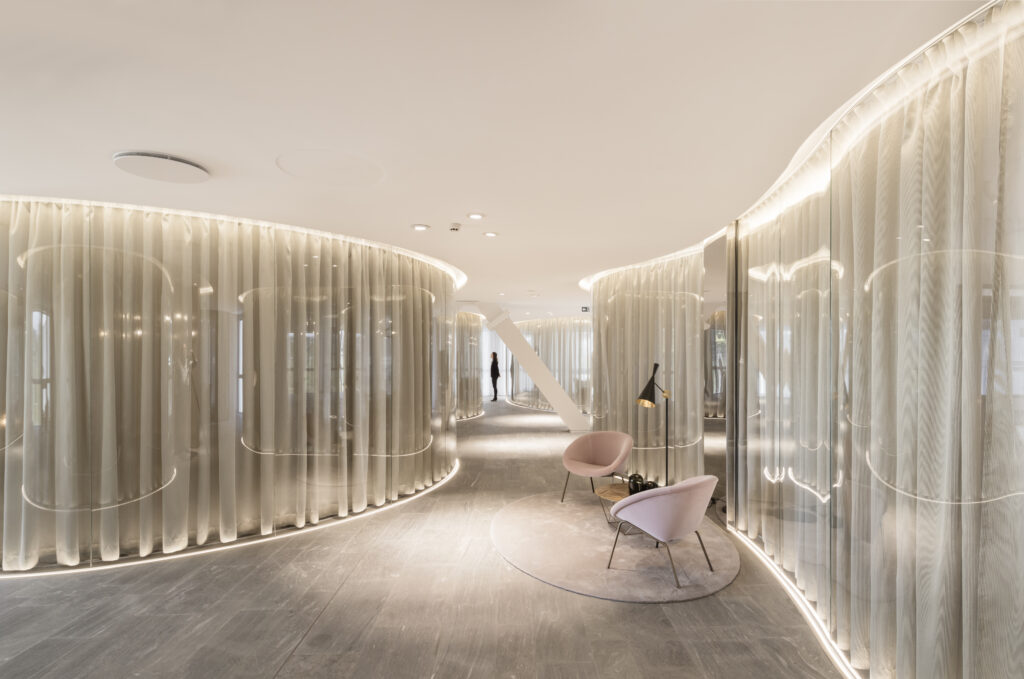
A notable example is a particular staircase we designed for a major global leader in technological instruments such as computers, smartphones, and tablets. In this case, our contribution was the metal structure that surrounds a huge glass “tube” placed inside a room.
The interlayer, along with the glass, becomes an important and wonderful example of how metal can accompany transparency to create architecture that stimulates the imagination and enchants the visitor.