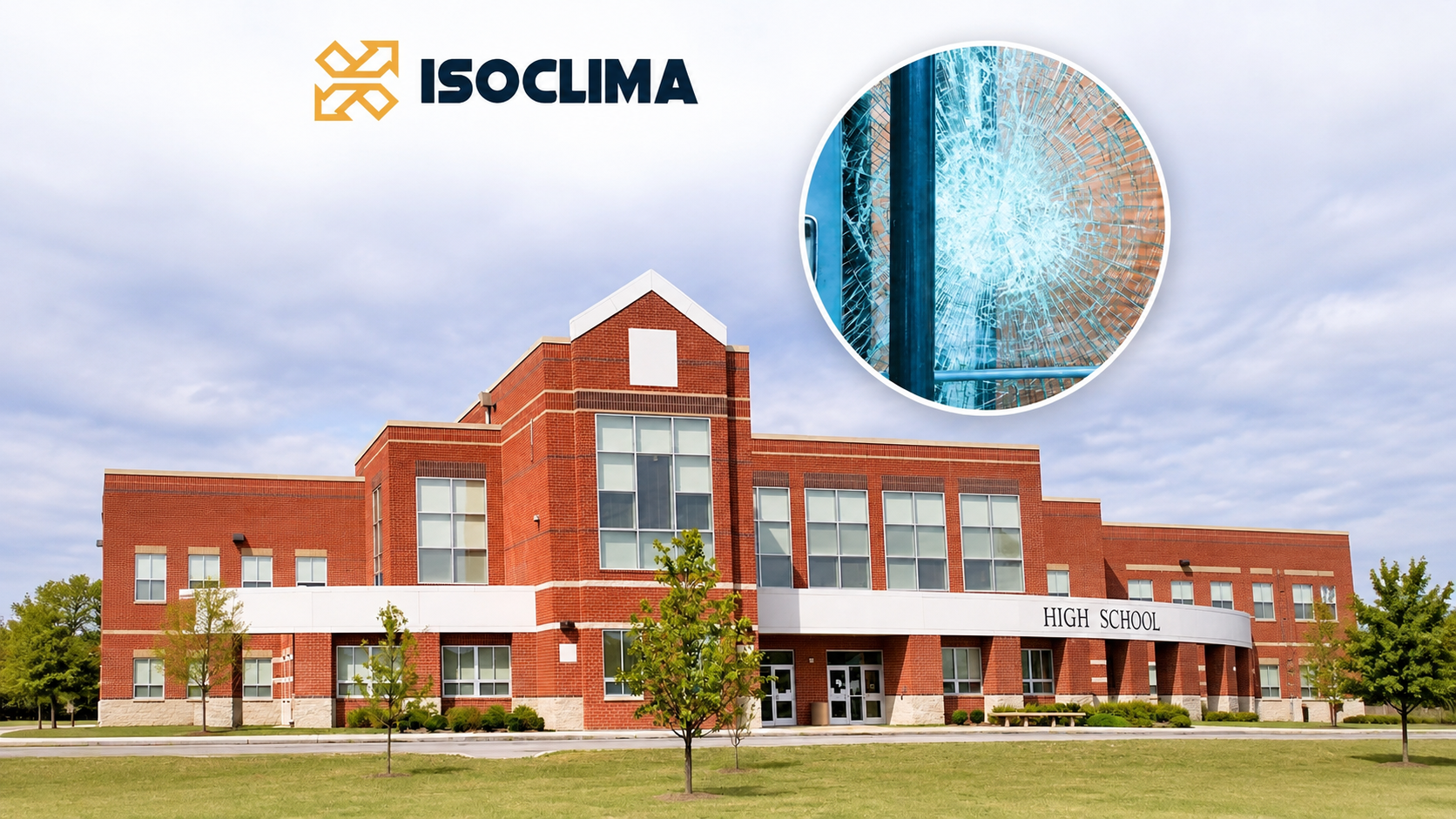
Security glazing at a school entrance can resist repeated blows and still fail to keep an intruder out. If the framing bends or the anchorage pulls loose, the glazing can shift or be pushed out of the opening, even when the interlayer remains intact.
In “Security Glazing in Education: Forced-Entry Testing Used in School Building Assemblies,” published in The Construction Specifier, Isoclima’s Derek Hubert covers the differences between safety and security glazing, common assembly failures, testing standards, and considerations for new construction and school security upgrades.
Safety Glazing vs. Security Glazing
Conventional safety glazing is designed to reduce injuries from accidental glass breakage. Standards such as ANSI Z97.1 and 16 CFR 1201 address how glass breaks and the hazards associated with broken fragments. However, meeting these standards does not establish resistance to repeated impacts intended to force entry.
Security glazing is designed to delay intrusion, giving school personnel additional time to initiate lockdown procedures and contact emergency responders.
During repeated impacts, laminated glass may fracture while its interlayer continues to hold the pieces together. As the strikes continue, the interlayer must resist stretching and tearing to prevent an opening from forming.
The surrounding framing and anchorage are equally important. Shallow glazing pockets, loose retention components, or inadequate anchorage can allow a damaged panel to shift or be pushed out of place. Even a strong laminate may fail if the framing cannot hold it in position.
Where School Glazing Assemblies Are Vulnerable
Forced-entry attempts often target openings that provide access to locks, latching mechanisms, or occupied areas.
Door vision panels can be vulnerable when repeated impacts cause deformation of the door or glazing pocket. Sidelights near locking hardware present similar concerns, while ground-level windows may have framing systems that were not designed for sustained impacts.
Evaluating the glass alone does not account for how the frame, anchorage, and surrounding construction respond during an attempted intrusion. Complete assembly testing provides a better indication of forced-entry resistance.
For existing schools, replacing the glazing without evaluating the surrounding assembly may not provide the intended level of protection.
Forced-Entry and Other Security Testing Standards
Security glazing is tested against different threats, and meeting one standard does not automatically establish resistance to another.
Common testing methods include:
- ASTM F1233 and UL 972: Evaluate resistance to forced-entry and burglary attempts using repeated impacts and specified tools.
- UL 752 and NIJ 0108.01: Evaluate ballistic resistance against specified firearms and ammunition.
- ASTM F1642: Evaluates glazing performance under blast loading, including the potential for hazardous glass fragments.
Forced-entry performance depends on how the complete assembly responds during testing. A system that resists a projectile, for example, may still be vulnerable to repeated impacts if the framing or anchorage fails.
Reviewing third-party test reports helps architects and specifiers verify the assembly’s tested performance before selecting a system.
Security Glazing Options for Schools
Several materials and systems are available for educational facilities, depending on the threats being addressed.
Laminated security glass uses multiple layers of glass and interlayers to resist penetration after breakage. Glass-clad polycarbonate combines glass and polycarbonate layers for applications requiring impact and ballistic resistance. Polycarbonate panels and window security films may also be considered for certain applications.
These options have different performance characteristics. Window films, for example, can improve fragment retention and delay intrusion, but they should not be assumed to provide the same protection as a fully tested security glazing assembly.
In new construction, security glazing can be incorporated into entrance vestibules, classroom openings, and other accessible areas. Existing facilities may require additional evaluation of framing, anchorage, and installation conditions before selecting an upgrade.
Cost and funding also influence school security projects. Reducing interlayer thickness, substituting weaker framing components, or eliminating anchorage details to lower costs can affect performance. Proposed substitutions should be reviewed against the project’s security requirements and supporting test data.
For assistance with security glazing design, product specifications, or AIA continuing education presentations, contact Isoclima or reach out to Derek Hubert directly at djhubert@isoclimasg.com.