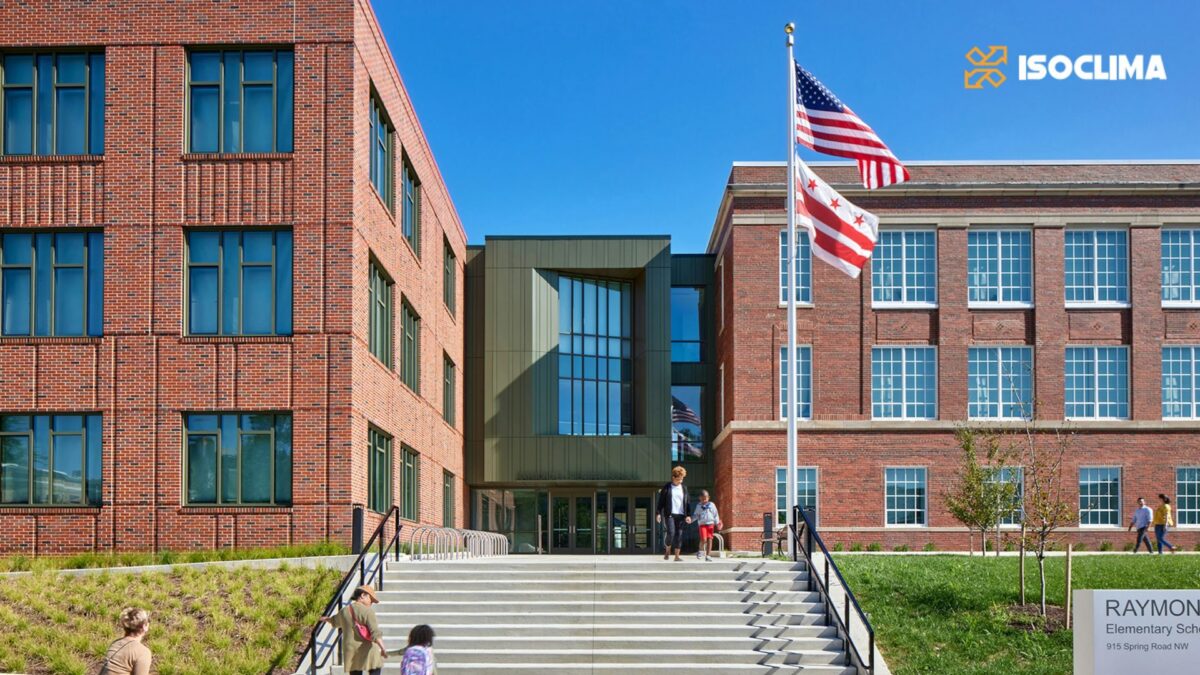
America ByDESIGN™: Designed for What Comes Next recently took viewers inside Raymond Elementary School in Washington, D.C., where the project incorporated Isoclima’s CHILDGARD® security glazing. Produced in collaboration with The American Institute of Architects, the episode also covered four other projects.
Raymond Elementary is a nearly 100-year-old school that added a 50,000-square-foot wing while preserving the character of its original 1920s building.
America byDesign™ – Raymond Elementary Renovation
Expanding a Historic School
The renovation replaced a 1966 wing with a larger addition containing classrooms, a gymnasium, a library, and a new entrance. The completed school totals 93,000 square feet and has space for 590 students.
The design, by STUDIOS, also incorporated geothermal wells, photovoltaic panels and energy-efficient building systems. Raymond Elementary achieved LEED Gold certification, is net-zero-energy ready and was designed to meet WELL standards.
Adding Security Without Giving Up Visibility
Security measures at school entrances and interior openings need to provide added protection while preserving the visibility, daylight and openness expected in an educational setting.
Raymond Elementary incorporated CHILDGARD® security glazing into its design. CHILDGARD® is laminated glass made with a proprietary security interlayer engineered to resist sustained physical attack during a forced-entry attempt. Isoclima has tested the glazing to forced-entry standards including ASTM F1233 and ASTM F3561.
CHILDGARD® can be used at entrance doors, vestibules, classroom doors, sidelites and accessible ground-floor glazing. It is available for both retrofit and new construction applications, giving school project teams options for existing facilities and new buildings.
The glazing also maintains clear views through doors and windows. That allows schools to add forced-entry resistance without replacing transparent openings with opaque barriers that can limit sightlines or natural light. CHILDGARD® can also be combined with Low-E and other high-performance glass options when a project needs to address energy performance and daylighting along with security.
At Raymond Elementary, those features supported the broader design approach by adding protection at key openings while preserving visibility, daylight, and the architectural character of the renovated school.
For years, project teams have had to make a choice. A building could be designed to feel open and welcoming, or built to provide higher levels of security. Rarely both. This challenge is most visible in high traffic retail storefronts, entry vestibules, reception counters, and public-facing transaction areas where clear sightlines are expected but protection is still required.
Advances in laminated security glazing are changing that equation. High-performance glass systems now allow architects and specifiers to meet forced-entry requirements while maintaining transparency and daylight. ACCESSGARD® from Isoclima is designed to deliver this balance.
Meeting ASTM F1233-08 Detention Requirements
Security glazing materials and systems are often evaluated against ASTM F1233-08, which measures resistance to forced-entry attacks using defined tool sets and timed attack protocols. Across U.S. retail, education, and civic projects, products tested to this standard are commonly specified in higher-risk environments such as:
Retail storefronts
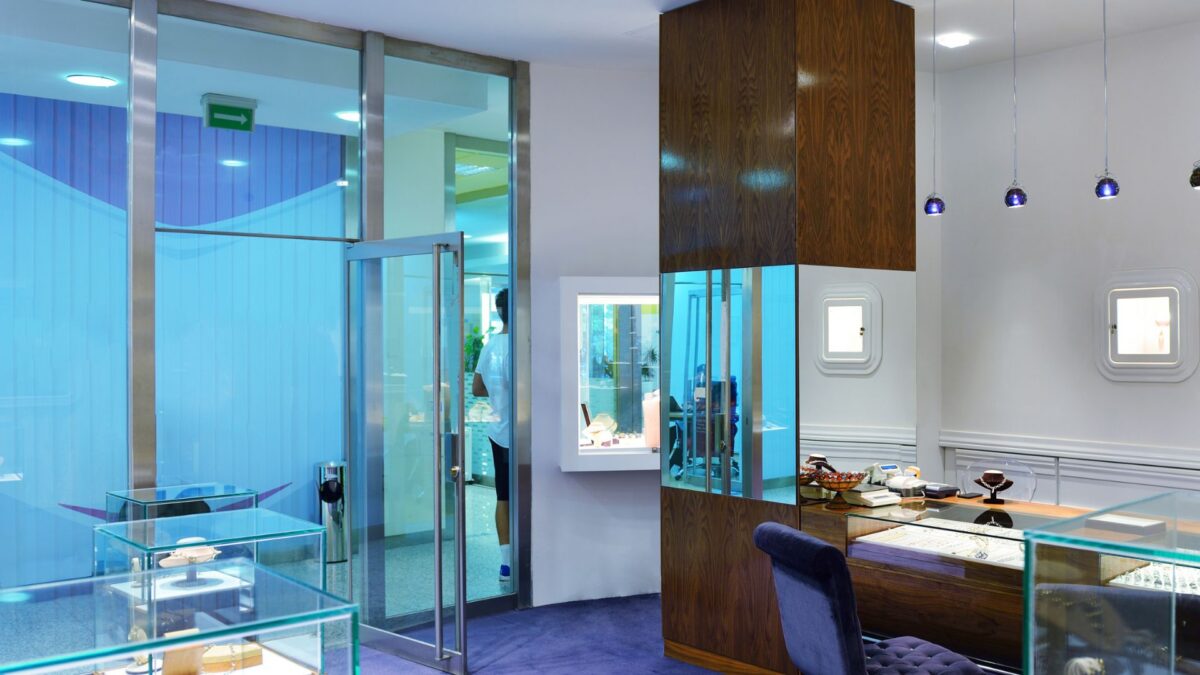
High-end jewelry stores
K-12 and higher education entry points
Government buildings
Courthouses and secure lobbies
Financial transaction areas
Transportation facilities
ACCESSGARD® is engineered and tested to meet ASTM F1233-08 detention criteria. This testing provides documented performance when resistance to manual attack is required, but full ballistic protection is not necessary.
For architects working in these environments, this offers an alternative to conventional safety glazing and heavier ballistic assemblies.
Designed for Real-World Retrofit Conditions
On renovation projects, products that perform well in testing may not fit easily into existing openings. Many high-security systems require larger framing cavities, added steel reinforcement, or specialty installation crews. That can complicate schedules and increase costs, especially in occupied buildings.
Isoclima’s ACCESSGARD® is designed to integrate with many standard commercial framing systems. For many projects, this can result in:
Less disruption during upgrades
Reduced need for custom framing
Faster installation in active facilities
Greater flexibility for phased security improvements
For retail fronts, schools, and public buildings operating under tight project schedules, this can help simplify security upgrades. At the same time, project teams often need to meet security goals without creating a bunker-like appearance.
While these challenges often appear in retrofit work, ACCESSGARD® is also specified in new construction where framing compatibility and installation coordination are important.
Where Isoclima’s ACCESSGARD® Fits in the Overall Security Strategy
ACCESSGARD® should be positioned within the broader project security strategy. Detention-grade forced-entry resistance serves a different role than ballistic glazing.
This system is typically appropriate when the design goal is to:
Delay forced entry
Deter opportunistic attacks
Support controlled access points
Upgrade existing storefronts or vestibules
Projects that require ballistic or blast protection should be evaluated against those specific standards. Final system selection should align with the project’s threat assessment, applicable codes, and overall security plan.
Supporting Safer, More Open Buildings
The industry continues to move away from the idea that security must appear heavy or institutional. Tested laminated glazing systems now allow design teams to reinforce vulnerable openings while maintaining the transparency and openness that retail, educational and civic buildings are intended to support.
Isoclima’s ACCESSGARD® provides a security glazing option for architects, specifiers, and owners, balancing safety, constructability, and design intent at building perimeters and interior control points.
The James A. Musick Facility in Orange County, California, was named the first-ever Readers’ Choice Facility of the Year by Correctional News. The 324,000-square-foot, $290 million campus replaces temporary structures with a permanent, 896-bed complex designed to support rehabilitation, healthcare access and long-term operational planning.
The facility keeps more services and supervision within individual housing units, reducing movement throughout the building. That approach depends on clear sightlines and secure materials that maintain visibility while preserving containment.
Isoclima supplied high-security glazing to CML Security as part of the project’s detention package. In correctional environments, glazing must maintain staff visibility while integrating with secure framing and detention hardware built for continuous use.
We develop protective glazing systems for correctional and other high-risk environments. Our portfolio includes laminated glass, glass-clad polycarbonate and multi-layer security assemblies engineered to provide containment, impact resistance and optical clarity where safety and supervision are priorities.
At Musick, secure glazing supports:
Controlled entry and perimeter integrity
Clear sightlines within housing units
Durable performance under continuous operational demands
Integration within secure building systems
The campus is expected to serve the county for decades, supported by a master plan that allows for future expansion. Long-term material performance and system coordination remain central to that objective.
Recognition as Facility of the Year reflects collaboration across design, construction and detention equipment partners. Isoclima was proud to provide high-security glazing for the James A. Musick Facility in partnership with CML Security.
Click here to read the article in Correctional News.
Glass is standard in U.S. schools. It brings daylight into classrooms, supports visibility, and helps spaces feel open. In many K–12 and higher education facilities across the United States, however, it can also become the fastest path inside during an unauthorized entry.
A 2024 survey of school safety professionals by Campus Safety Magazine found that glass doors and windows are the perimeter elements most likely to fail during an intrusion. Respondents also cited frequent breakage due to vandalism and unauthorized access attempts, reinforcing a persistent vulnerability across K–12 schools and college campuses.
When glazing fails quickly, other security measures lose effectiveness. The overall security of an opening depends on the glazing holding long enough for response procedures to take effect. For school administrators, facilities teams, and U.S.-based design professionals, this shifts the conversation toward how glazing performs under deliberate attack, not accidental impact.
Where Do School Security Plans Often Break Down
Unauthorized entries often begin at glazed openings. After hours, common targets include:
Door vision panels
Sidelights
Ground-level windows
In many cases, only basic hand tools are used.
From the outside, these incidents may resemble vandalism. In reality, they show how quickly standard glazing can fail and how easily an opening can be created before other security measures or responders have time to act. In higher-risk U.S. school environments, security assessments indicate that glazing is often targeted first to weaken the barrier, followed by forced-entry attempts.
In both scenarios, glazing becomes the initial failure point, effectively creating a shortcut that allows an intruder to bypass otherwise code-compliant doors, locks, and hardware.
The challenge is not eliminating glass. Daylight, visibility, and supervision remain important in learning environments. The goal is to make sure glass functions as a time barrier, rather than an immediate access point, when attacked.
The Value of Delay
Time defines the outcome of an intrusion. According to FBI and ALERRT Center data, nearly 70 percent of active shooter incidents in the United States end within five minutes. More recent 2024 FBI data specific to educational settings shows an even shorter window, with the average incident lasting three minutes and 18 seconds.
With average U.S. police response times often exceeding seven minutes, school safety planning increasingly focuses on delaying entry. Creating a time barrier allows staff to:
Secure occupants
Initiate lockdown procedures
Communicate with first responders
Standard safety glass, including tempered glass and basic laminated glass, can fail in seconds when subjected to deliberate force. Security-focused glazing systems engineered to remain in the frame under repeated impact extend that timeline.
A U.S. elementary school retrofit showed that replacing standard door vision panels increased breach time from seconds to several minutes, with no visible change to the building.
Is Code-Compliant Glass Enough?
Most glass installed in U.S. educational facilities meets life-safety requirements under ANSI Z97.1 or 16 CFR 1201. Tempered glass and basic laminated glass are designed to reduce injury during accidental impact by breaking in a controlled way. That performance satisfies code, but it is not intended to address forced entry.
Security glazing serves a different purpose. It is engineered to resist forced entry and remain in the opening under repeated physical attack. A school can comply with every applicable building and life-safety code and still have glazing that offers little resistance to unauthorized entry.
This vulnerability is most common in older U.S. school buildings, many of which were constructed decades ago before security risks influenced glazing selection. In those facilities, glass often becomes the weakest point in the building envelope, even when doors, locks, and hardware meet current requirements.
Targeted upgrades to specific areas can improve protection without requiring a full-facility renovation, including:
Main vestibules
Administrative suites
Ground-level openings
Maintaining Daylight and Visibility While Improving Security
Concerns about school security often focus on appearance and atmosphere. Educators and parents want buildings that feel open and appropriate for learning. Daylight, visibility, and supervision remain core priorities in U.S. school design.
Security glazing is designed to support those priorities, functioning like conventional glass under normal conditions while resisting access during an attack.
How CHILDGARD® Fits into Educational Safety Planning
CHILDGARD® is a laminated security glazing system engineered to resist forced entry through a proprietary interlayer designed to remain intact under repeated physical attack. Developed specifically for U.S. K–12 educational environments, it addresses security performance expectations commonly applied in American schools.
Manufactured by Isoclima, CHILDGARD strengthens vulnerable glazed openings while preserving daylight, visibility, and the open character of learning spaces.
The system meets applicable safety glazing requirements and has been tested to recognized forced-entry standards, including ASTM F1233 and ASTM F3561. It integrates with industry-standard door, frame, and window systems and can be specified for both retrofit and new-construction projects requiring targeted security upgrades.
Learn More
Understanding how glazing performs under deliberate attack is an important part of educational safety planning. To learn more about CHILDGARD® laminated security glazing for educational environments, click here.
Frequently Asked Questions About Security Glazing in Schools
Is security glazing only used in K–12 schools? No. Security glazing is used in preschools, K–12 schools, and higher education facilities across the United States. Applications vary based on building type, occupancy, and the results of a site-specific risk assessment.
Does security glazing replace other school safety measures? No. Security glazing supports broader safety planning that includes access control, staff training, communication systems, and emergency procedures. It functions as part of a layered approach by providing additional time for other measures to take effect.
Is security glazing required by U.S. building codes? In most cases, no. U.S. building codes primarily address impact safety intended to reduce injury from broken glass, such as ANSI Z97.1 and 16 CFR 1201. Security glazing is typically a performance-based decision informed by site conditions, security objectives, and local risk factors.
Can existing school buildings be retrofitted with security glazing? Yes. Many schools retrofit door vision panels, sidelights, and selected openings using existing frames, provided the glazing pocket can accommodate the required thickness and the framing is properly anchored.
What is CHILDGARD® and who manufactures it? CHILDGARD® is a laminated security glazing system designed to resist forced entry and remain in the opening under repeated physical attack. Developed specifically for educational environments, it is manufactured by Isoclima and used in U.S. schools to strengthen vulnerable glazed openings while preserving daylight and visibility. It has been tested to ASTM F1233 and ASTM F3561 standards.