Isoclima
10/02/2022
Share this post
How do you make glass resistant to impacts and mechanical stress? There are essentially two processing techniques that allow this: chemical tempering and thermal tempering. In thermal tempering, as the name suggests, the processing is based on temperature. The glass is heated to a very high temperature, around 600°C, and then rapidly cooled, which makes it not only resistant to impacts but also to thermal shocks. In fact, a glass that has not undergone this process will break between 50 and 100°C, while a thermally tempered glass is perfectly balanced to resist various temperature fluctuations.
The chemical tempering processing
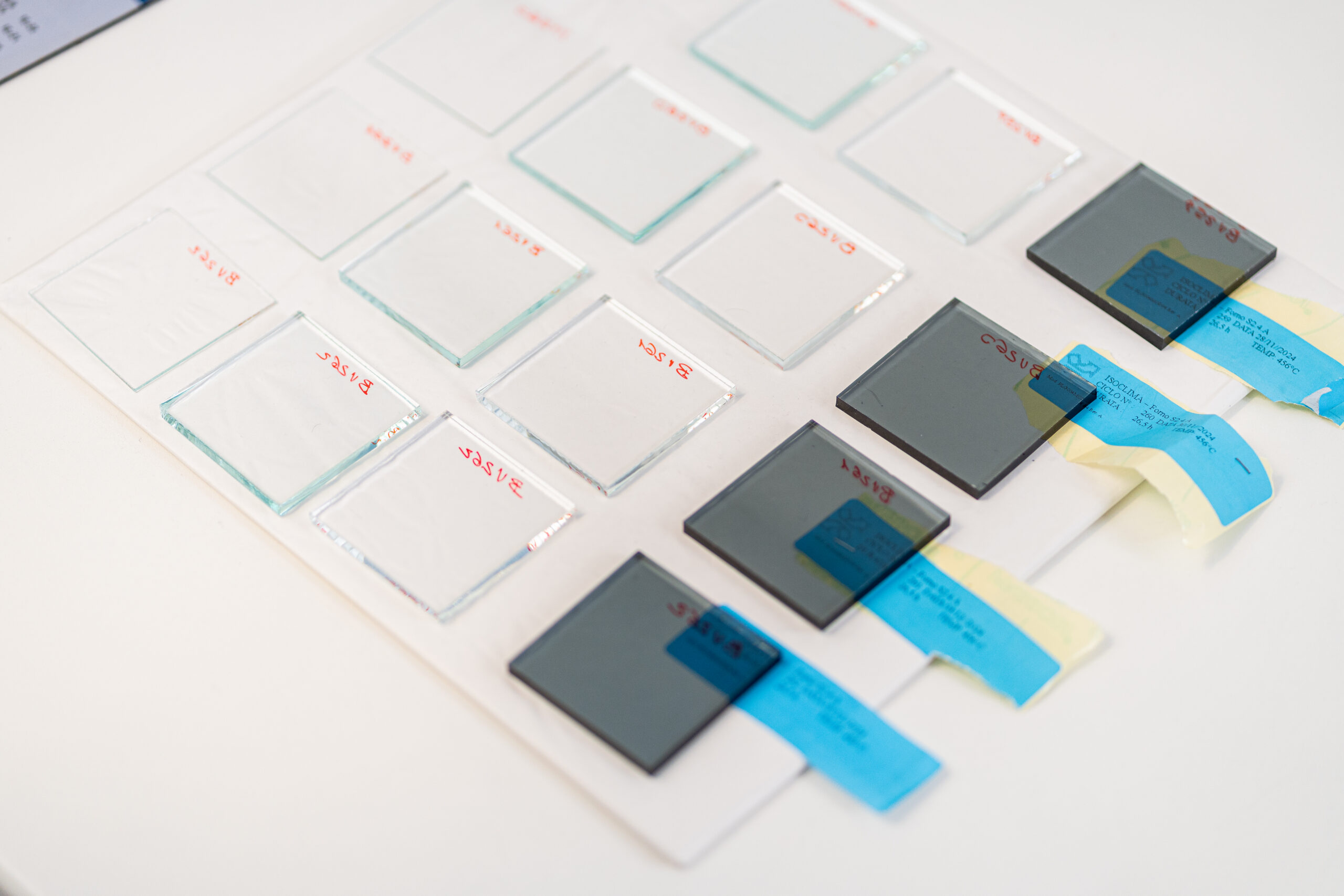
Chemical tempering works differently from thermal tempering, although the final purpose of the product is the same: to resist impacts and stress. Chemical tempering does not require high temperatures, which can be an advantage. On the other hand, however, it requires a very specific knowledge of raw materials to avoid issues during processing. While thermal tempering poses the risk of deforming the object due to high temperatures, this does not occur with chemical processing. The product obtained from chemical tempering is also suitable for complex-shaped objects, with a wide range of applications. With chemical tempering, part of the sodium ions in the surface layers of the glass are replaced by potassium ions, which are larger in size and promote the glass’s resistance. This happens at a temperature lower than the normal glass processing temperature of around 450°C.
Details and advantages of this processing
The compressed layer is very thin, in fact, chemically tempered glass is widely used in the automotive sector, also for its transparency.
For some, it may be a deterrent, but if processed correctly and with innovative technologies, chemically tempered glass is perfect for its intended use. The ion exchange we mentioned earlier takes place in molten potassium salt baths. During the process, an important phenomenon occurs: the level of residual stress is characterized by surface compression tensions compensated by tensile stresses inside the glass.
Since this processing represents our core business, we couldn’t help but invest in it. The first chemical tempering plant was installed in 1994 and processed sheets measuring 3.2 meters by 2 meters, a milestone that was unimaginable at the time and still in operation today. Since then, we have made great strides, and 2022 marks a significant turning point for us. We have installed a plant capable of processing sheets up to 10 meters, a capability that only our Este facilities can provide. And the first incredible results have not been long in coming: the laminated spherical glass intended for the naval sector is a product of high engineering and aesthetics, with exceptional characteristics such as multiradius 3D curvature, perfectly aligned sizes and geometries, and precise final performance that unmistakably bears our signature.