Isoclima
04/03/2022
Share this post
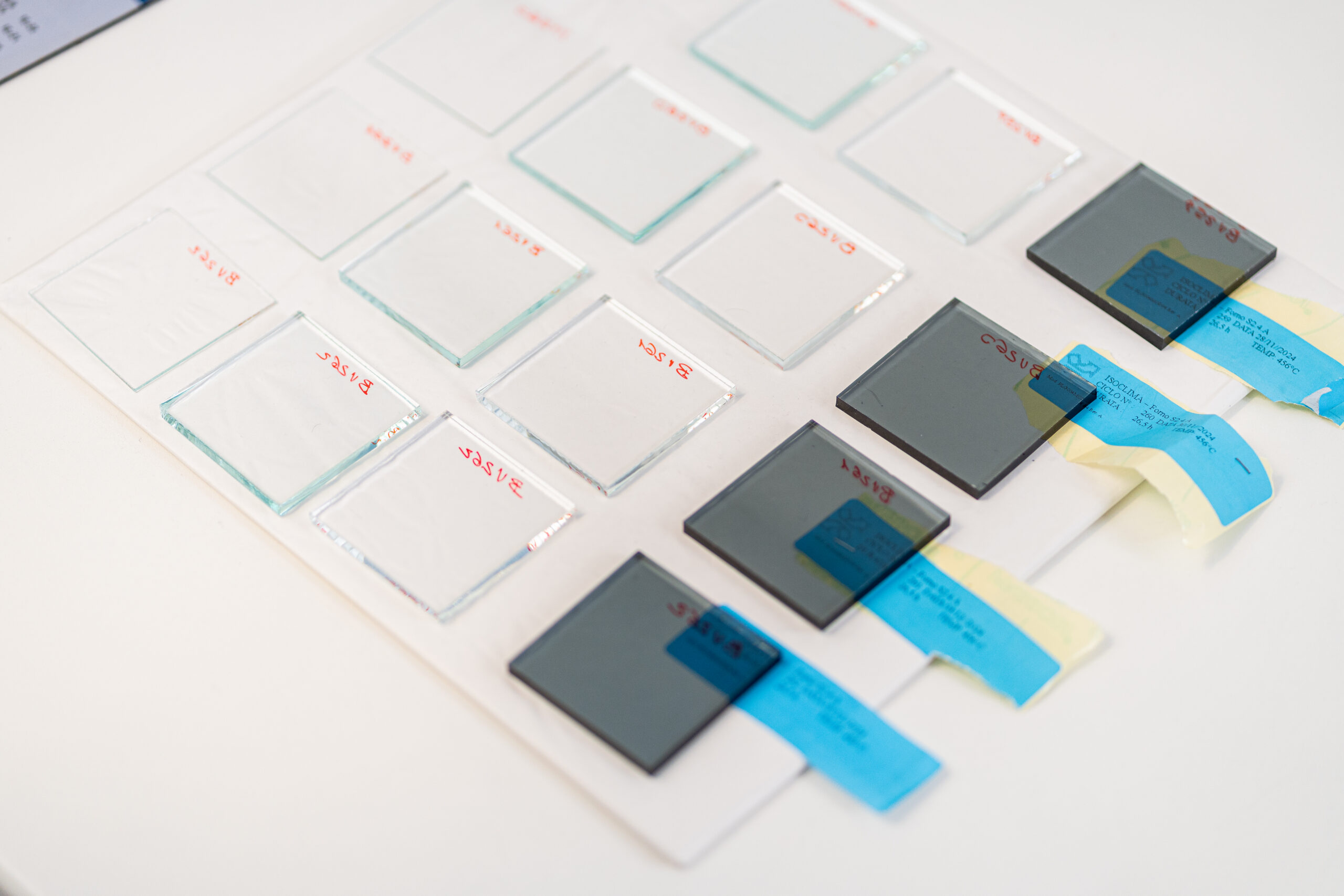
A thermochemical cycle among the most reliable in the world, a processing that requires a deep knowledge of chemistry, based on sector studies and scientifically proven concepts. Talking about chemical tempering for ion exchange is like “diving” into a chemistry textbook and starting to flip through the pages full of formulas and principles resulting from cutting-edge studies. But let’s take a step back: why is chemical tempering used? When glass is subjected to tensile stresses, the presence of microscopic cracks (called fissures) on the surface intensifies the stresses at the edges, causing the cracks to spread and ultimately resulting in the glass breaking. These fissures represent the primary reason for the low mechanical resistance of the glass to stress, which is why a counteracting intervention is necessary to prevent the appearance of cracks.
How to solve the glass fissures
At this point, you don’t go directly to chemical tempering for ion exchange, but you choose. Once it’s understood that an internal surface precompression layer must be introduced to make the glass more resistant, the compression can be done in two ways: thermally or chemically. While thermal tempering works at high temperatures, chemical tempering allows overcoming some limitations of thermal tempering and achieving a more efficient product. Chemical tempering is praised and appreciated for guaranteeing a reduced thickness of the glass, regardless of its intended shape. It also allows maintaining perfect surface geometry, resulting in significantly superior tempering levels.
If the glass has a specific thickness, has complex curvatures, and needs to resist mechanical stress much higher than normal, thermal tempering is not the right option, and chemical tempering is applied, resulting in a stronger and more durable glass.
Ion exchange
So why do we talk about chemical tempering and ion exchange? In chemical tempering, the glasses to be treated are immersed in a bath of molten potassium salts at a temperature above 380°C, causing an exchange between the sodium ions on the surface of the glass and the potassium ions in the salt. Potassium ions are larger than sodium ions, which allows for the establishment of a system of residual stresses characterized by compression tensions on the surface balanced by tensile stresses inside the glass. In short, chemically tempered glass has a higher surface tension, and resistance compared to thermally tempered glass. In the event of breakage, thermally tempered glass shatters into small, non-sharp fragments, while chemically tempered glass breaks into larger, less sharp pieces than untreated glass. To break chemically tempered glass, a force 10/15 times greater than that required for thermally tempered glass is needed, which can tolerate stress 4/5 times higher than untreated glass. Due to the higher resistance of chemically tempered glass, do you still have doubts about which to choose?