Innovation & Tech
3 min read

Isoclima
23/06/2025
Share this post

In the world of innovation applied to materials, there are events that truly catalyze technical, scientific, and industrial thinking on a global scale. One of these is Glass Performance Days (GPD), held in Tampere, Finland: a biennial conference considered today the most authoritative platform worldwide for research and technological evolution in the field of glass.
Founded in 1992, GPD is neither a simple trade fair nor a traditional conference: it is an ecosystem that brings together scientists, manufacturers, architects, engineers, and innovators to discuss the challenges and opportunities of a material that is radically changing the way we build, protect, and see the world.
It’s not just about lighter or stronger glass, but about smart transparencies, dynamic surfaces, functional coatings, energy efficiency, and advanced safety—all with a focus on the future.
The 2025 Edition: Numbers and Vision
Glass Performance Days 2025, held from June 10 to 13 at the Nokia Arena in Tampere, confirmed the event’s central role as a privileged meeting point for global innovation.
With over 500 participants from more than 40 countries, more than 130 scientific papers, and 120 sessions including workshops and technical lectures, the conference revolved around the theme “GLASS – THE IN/VISIBLE IMPACT”: a deep reflection on the tangible and invisible impact that glass has on our society, technological systems, and the future of construction and mobility.
The Role of Guglielmo Macrelli
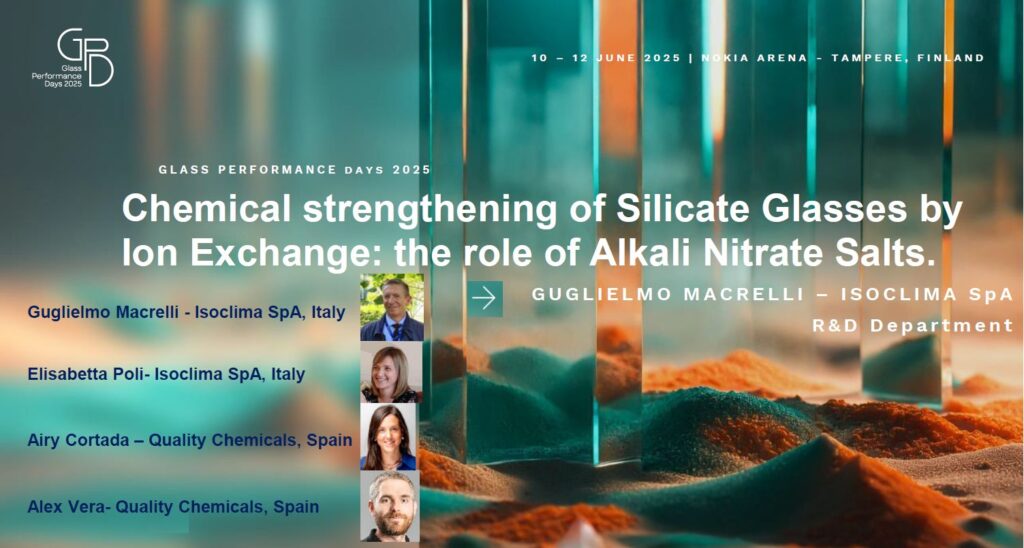
Among the international speakers at the 2025 edition, the contribution of Guglielmo Macrelli, Chief Scientist Advisor – Isoclima Group, stands out. Macrelli is a physicist specializing in ion exchange for chemical strengthening of glass and a seasoned scientific consultant.
Guglielmo was featured in a lecture within the “Tempering Session,” one of the most technical and well-attended moments of the conference, where he presented an in-depth study on the optimization of chemical strengthening processes.
The paper, the result of a collaboration between Isoclima SpA and Quality Chemicals, was co-authored with Elisabetta Poli, R&D Director at Isoclima, and with Airy Cortada and Alex Vera, R&D Managers at Quality Chemicals (Spain). The work provided new interpretative models on the behavior of glass subjected to chemical treatments, with particular attention to the relationship between ion diffusion and mechanical properties.
“It’s great to be a speaker in the GPD 2025 glass tempering session! Many thanks to Isoclima SpA for supporting me in this task, to Elisabetta Poli, R&D Director at Isoclima, and to Airy Cortada and Alex Vera of Quality Chemicals / Spain for co-authoring the paper and the presentation I will deliver at the conference.”
— Guglielmo Macrelli
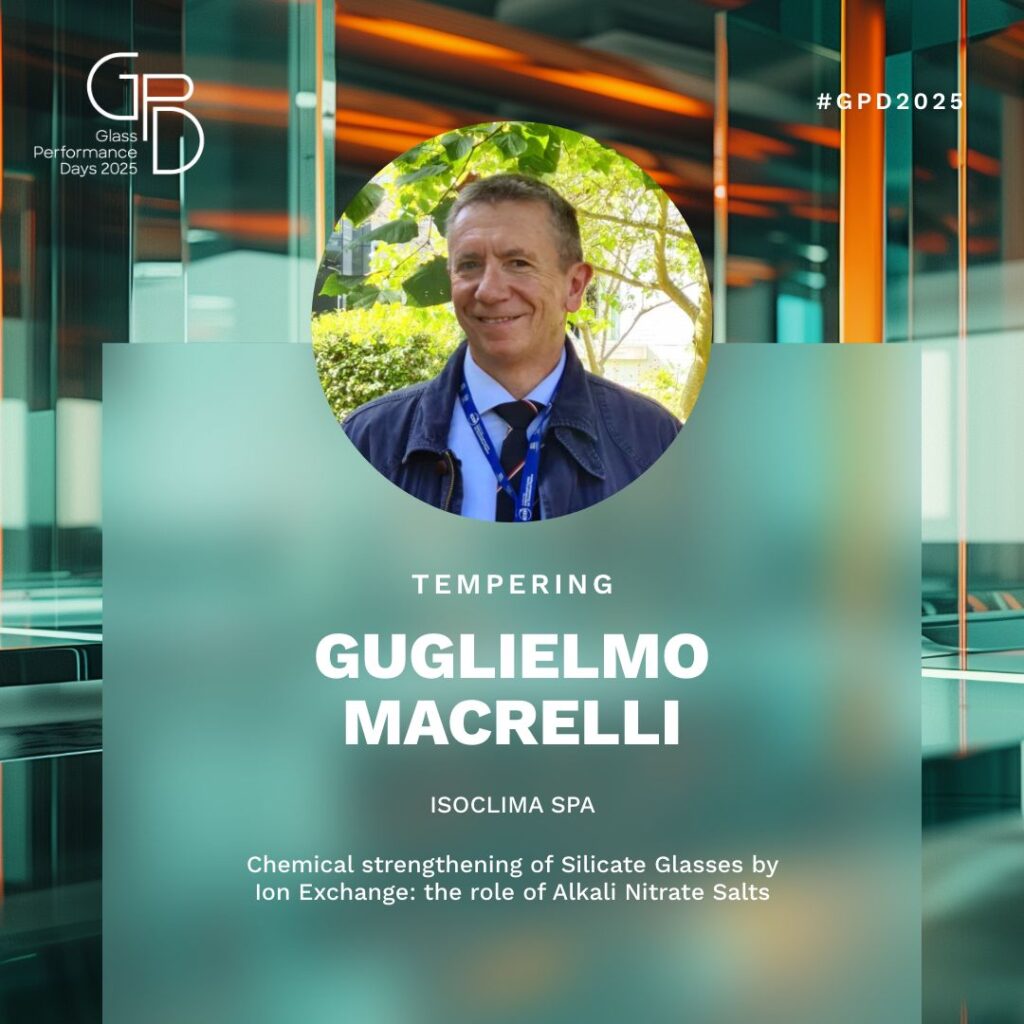
The lecture’s content attracted audience attention for the clarity with which process parameters and experimental results were explained, demonstrating how a scientific approach can translate into tangible benefits for the quality and safety of technical glass. The contribution represented a perfect example of dialogue between theoretical research and advanced industrial production.
GPD as an Ecosystem of the Future
The presence of figures like Guglielmo Macrelli confirms GPD’s vocation to be much more than a conference: it is a living laboratory where visions are exchanged, strategies are discussed, and solutions are experimented.
Here, glass is not just a material: it is a field of continuous innovation, where every technological evolution has the potential to transform the way we live, travel, and build.
Read more about this news:
Chemical strengthening technology by Ion Exchange