The “low-altitude” economy is taking off

svitlana
Isoclima

13/06/2025

Share this post
featured-image

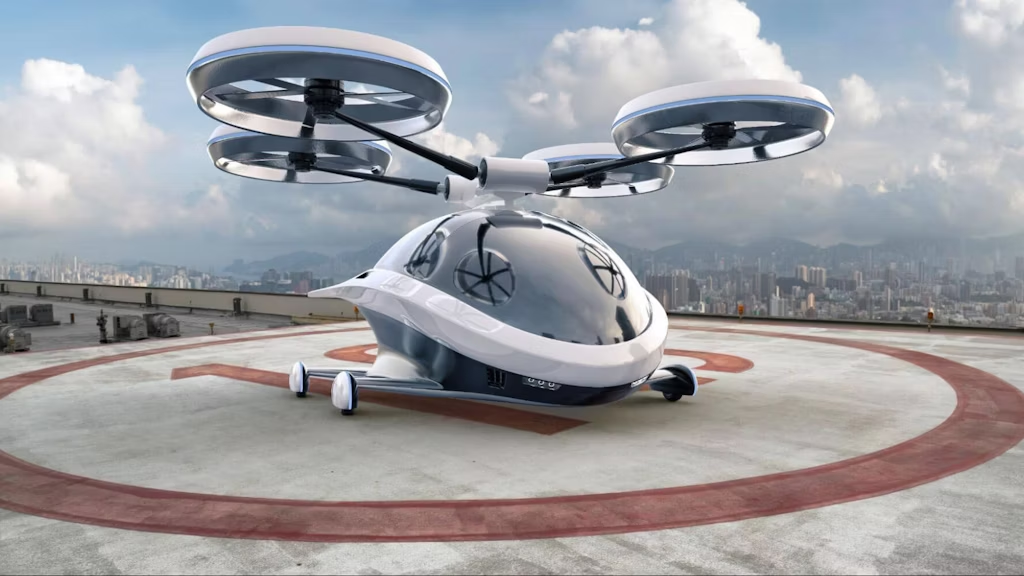
A blend of a helicopter and drone, electric vertical take-off and landing (eVTOL) is propelling the low-altitude economy forward.

The so-called “low-altitude economy” is an emerging and fast-growing economic sector focused on activities, businesses, and services operating in the airspace below 3,280 feet. This new frontier is largely being driven by the rise of eVTOLs—electric vertical take-off and landing vehicles.

According to BofA Global Research, civil adoption of eVTOLs worldwide could increase by as much as 62% between 2025 and 2030. Positioned somewhere between a helicopter and a drone, eVTOLs offer several advantages: they are safer, more environmentally friendly, quieter, and more cost-effective than traditional helicopters.

Technically, an eVTOL is made up of five key systems: power, avionics, structure, energy and thermal management, and assembly components.

The potential applications for eVTOLs are wide-ranging. BofA identifies six main use cases: public security, logistics and delivery, emergency medical and firefighting operations, tourism, urban commuting, and intra/intercity transportation.

Link: https://institute.bankofamerica.com/transformation/low-altitude-economy.html

Read more

Stories of Innovation

View all in Innovation & Tech
Aircraft glass: technical characteristics, materials and regulations
Aircraft windows are not simple transparent components. They are structural elements. They must withstand extreme stresses and guarantee passenger safety throughout every phase of flight. For this reason, their production requires specific materials and rigorous engineering processes. In addition, every stage is subject to strict international regulations. In this article, we look at the technical …
View article
Yacht glass: custom solutions between luxury and security
The luxury yachting sector places particular demands on glass. No other industry faces the same challenges to the same extent. On board a superyacht, glass is not simply an architectural element. It is an integral part of the structure. It contributes to the safety of the vessel. And it defines the onboard experience. Designing yacht …
View article
Smart glass for architecture: a complete guide to intelligent glazing
What is smart glass Smart glass, or intelligent glazing, is a glazing solution that can change its own optical properties. It can adjust transparency, opacity and its ability to filter light and heat. This happens in response to an external stimulus: electrical, thermal or light-based. Traditional glass keeps fixed characteristics over time. Smart glass works …
View article