Innovation & Tech
4 min read

Isoclima Group
18/08/2026
Share this post
The luxury yachting sector places particular demands on glass. No other industry faces the same challenges to the same extent. On board a superyacht, glass is not simply an architectural element. It is an integral part of the structure. It contributes to the safety of the vessel. And it defines the onboard experience.
Designing yacht glass therefore means reconciling three needs: aesthetics, technical performance and regulatory compliance. Every component must withstand extreme operating conditions, typical of the marine environment.
Why a superyacht requires special solutions
On board a yacht, glass is subjected to stresses that a building never encounters. Waves, structural vibrations, thermal cycling, salt exposure and continuous UV radiation put every material to the test.
Added to these stresses are the constraints typical of naval construction. Dimensions and weight, in particular, directly affect the vessel’s performance: every kilogram counts.
Yacht glass must also comply with the standards set by naval classification societies. These regulations govern mechanical strength, fire behaviour and watertightness. For this reason, design requires a dedicated engineering approach. Materials, laminations and treatments are selected according to the specific application: windscreens, side windows, portholes, sunroofs or glazed walls in common areas.
Large-size glass and complex shapes
Contemporary superyacht design favours wide, continuous glazed surfaces. Often curved, these surfaces maximise natural light. They also increase the sense of openness to the sea.
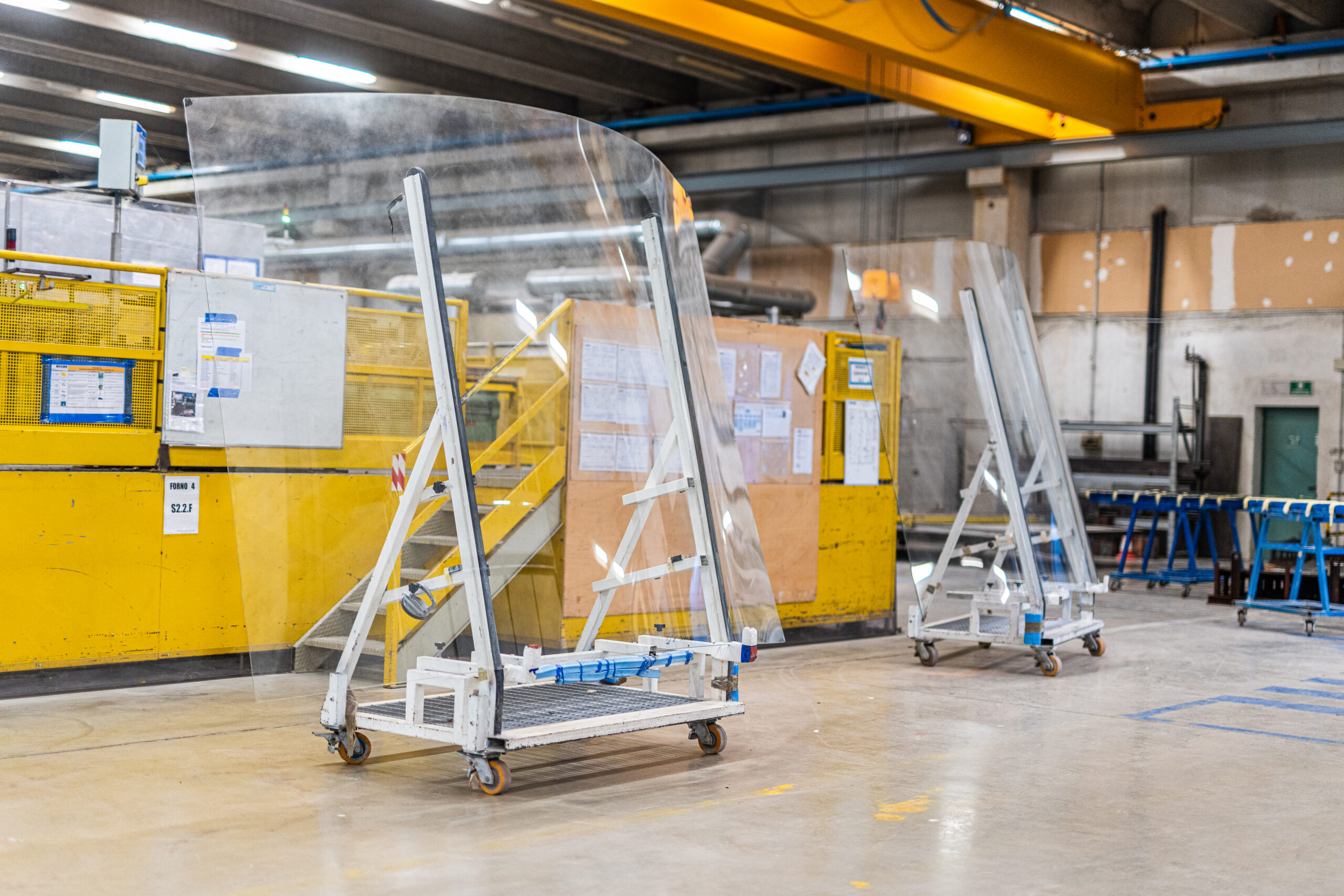
Producing large panels with complex geometries brings significant technical challenges, though. Glass curving must be controlled with precision. Dimensional tolerances require careful management. And integration with the hull structure adds a further layer of complexity.
Processing involves tempering and lamination calibrated with care. This ensures optical uniformity even over large surfaces, avoiding visual distortion that would compromise the onboard experience. Design also accounts for the vessel’s dynamic behaviour: the glass must absorb flexing and vibration without generating localised stresses that would reduce its durability over time.
Smart glass and privacy on superyachts
Adjustable privacy is a central theme in superyacht interiors. Owner’s cabins, lounges and spa areas call for flexible solutions. Smart glass technologies respond well to this need.
Electrochromic and liquid crystal glass allow the opacity of the surface to be varied electrically. This removes the need for curtains or mechanical shading.
This solution offers two main benefits. On one hand, it maintains visual continuity with the surroundings even when opaque. On the other, it reduces the footprint of shading elements and simplifies maintenance. Integrating smart glass systems, however, requires careful evaluation: energy consumption, resistance to the marine environment and compatibility with the other onboard electrical systems.
The custom design process
Every yacht glazing project starts as shared work. Shipyard, design studio and glass manufacturer collaborate from the early stages.
The process begins with an analysis of the vessel’s requirements. This analysis covers expected structural loads, applicable classification regulations and the aesthetic specifications set by the interior and exterior design project.
Based on this data, technical drawings and prototypes are developed. These then undergo mechanical, thermal and, where required, ballistic testing. Only once validation is complete does production of the final components begin, calibrated to the vessel’s specific dimensions and curvatures.
This approach integrates naval engineering expertise with technical glass manufacturing. The result is bespoke solutions, able to meet the criteria of safety, performance and design: essential elements for the luxury superyacht segment.